Spend any time around a group, or gang, of bikers, and you're bound to hear some biker slang. What is it they're saying? What do they mean? "Gang" is a relative term when it comes to bikers; that is, the riders of motorcycles who band together into motorcycle clubs. There are actually legitimate motorcycle clubs, although that may not be what someone thinks of when they think of biker gangs.
Ride That Motorcycle! Whether a biker rides alone, as part of a motorcycle club or gang, bikers enjoy their own subculture and slang. Here are the explanations for a few of the most commonly-used slang terms.
One Percenters. The outlaw bikers (those who seek that designation) have their own unique subculture. They often call themselves the "One Percenters." That designation comes from a riot that happened during a motorcycle rally in California in 1947. The riots, which may have been exaggerated in the media, so captured national attention that Life magazine did a story on them.
The picture they used, of a very fierce-looking biker surrounded by beer bottles, caused the American Motercycle Association (AMA) to respond. They swore that 99 percent of all bikers were upright citizens and that it was the other one percent, or the "One Percenters," who caused all the trouble.
To this day, the name has stuck.
Back Door. The last rider in a group ride. Customarily, the most experienced motorcycle rider. Also known as sweep or tail gunner.
Citizens and Independents. Not all bikers are members of gangs or have affiliations with a motorcycle club. These bikers are referred to as "citizens" or "independents."
Colors. Bikers often dress in the traditional black leather biker uniform, but if you take notice, you'll see many wear vests embroidered with various patches. The patches, or their "colors" as the bikers call it, have an entire slew of meanings. They usually have patches to show which club they belong to and which other clubs they are affiliated with. New bikers who undergo an initiation rite and are accepted are "patched." That means they've earned their stripes - or patches, in this case - and they can now officially wear the patch on their clothing.
Domes and Cuts. All bikers need to wear a "dome," the biker slang term for a helmet. Depending on their style preference, the biker may also wear "cuts," a denim jacket from which the sleeves have been cut. It frequently serves as a canvas for patches and logos. It is usually worn as the outside layer of clothing, often worn over a leather jacket.
Eating Asphalt. Crashing your bike.
Front Door. The first rider in a group ride.
Road Name. The vest or jacket may be emblazoned with the biker's "road name" - his or her nickname that he goes by in the motorcycle club or gang.
Touring Bike. A Weekend Warrior (or non-rider, if he's a Waxer), might invest in a Touring Bike. That's one built for comfort and flair, and is avoided by bikers who are looking for speed and handling.
The good news is that if the weekender ever decides to sell his bike, it really will be a mint (and unused) motorcycle!
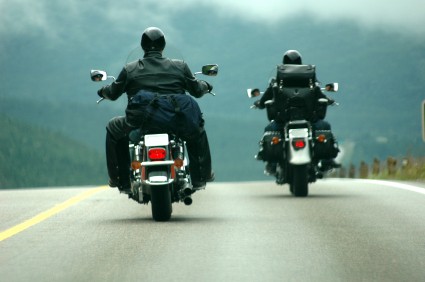
If you pass by a motorcycle rider on the road, you might be able to tell if he's taking this seriously, or if he's just the Weekend Warrior or Waxer variety of biker.
One way is how he rides the bike. Is he sitting straight up, hair in the wind, enjoying the sunshine of the day? He might just be a really happy biker, but chances are he's less than a professional.
That's because serious riders know that the wind hitting them square in the chest - the attitude of Mr. Happy Biker - does a lot to reduce the aerodynamics of a motorcycle ride.
The Tuck and Ape Hangers. The serious biker could take several stances while riding the bike. One is "The Tuck" where the biker keeps his head low and his arms tight to his sides. He makes himself one with the motorcycle, so as to reduce the "drag" of the wind over both him and the bike.
Other bikers prefer to enjoy the straight-up form of "Ape Hangers," which are high handlebars which rise up to the rider's shoulder.
Trial Riding. Some bikers may participate in racing events with their fellow enthusiasts. "Trial Riding" involves an unerring ability to control the bike over terrain (much of this type of sport riding is done on off road competitions.)
These kind of bikes are built specially for the sport. They're very light for maneuverability, and because the biker is constantly using the cycle for jumping, twisting and turning, he's so involved in the sport, he rarely sits down. Because of that, and the weight factor (you go faster with less weight on the bike), the Trial bikes usually are not equipped with seats.
The expert biker may "thrash" it, as in riding it with attitude. He may seek out roads with "twisties"; that is, a road with hairpin turns that make riding the cycle an act of skill and daring (and of course, thrilling!)
This kind of rider "twists the wick" (steps on the accelerator to get that much-needed speed.)
This is a guy who is seeking "the Ton," or who may ride at speeds clocking in at 100 mph. In American biker slang, there is also the Double Ton, or the Double, which is 200 mph. Not that riders ever go that fast, but for the professional who has a need for speed, it's the goal towards which he really is driven.Waxer
Your weekend biker neighbor might also be a more of a "waxer." That's someone lifestyle bikers sneer at. At least the Weekend Warrior gets on the bike, even if it's only on weekends. The Waxer is the guy who takes out his highly expensive and chrome-plated cycle, but he takes out only as far as the driveway.
That's because he washes nonexistent dirt off it, then waxes and waxes and waxes it until it shines like a diamond.
Weekend Warriors. Is your neighbor a weekend warrior? That's the guy who drags a highly tricked-out motorcycle for road trips on Saturday and Sunday. He's the guy with the leather chaps, and of course, the black leather jacket, not to mention the mirrored aviator sunglasses. The outfit is of note because, like the bike, it usually looks brand new and hardly used. He may not be a very good bike rider, but he's arrayed in his sartorial splendor for a sunny ride down the interstate!
The Wild Ones. The stories about bikers, their morals (or lack thereof) and mores can almost be precisely pinpointed to 1953. That was the debut of the ultimate biker film, the granddaddy of all outlaw biker flicks: The Wild One, starring Marlon Brando.
It was everything about Brando and his biker gang that entranced moviegoers. They loved his sneer, his black leather jacket, the entire outlaw attitude. The Wild One, and Brando's portrayal of the biker gang leader, started a surge and interest in everything biker, including biker slang. That fascination continues unabated to this day.
Let it be known, though: not all biker gangs or motorcycle riders are "outlaws." In fact, the vast majority of them aren't. The American Motorcyclist Association (AMA) gives its sanction to that majority of legitimate biker clubs. They wear AMA patches, signifying their desire to be known as legit biker groups.
Many AMA biker organizations devote their time and energies to community activities and charities and hold sessions to teach the general public about motorcycle safety, so that the untutored riders can hop on a bike and not cause or become the victim of an accident.
Unfortunately, for all the good they do, and the positive image they wish to portray, it's not always the AMA bike clubs that most people think of when they think of biker gangs. It's the outlaw type bikers who capture the imagination. And they do, indeed, exist, even more than a half century after Brando's iconic The Wild One performance.
Site:grammar.yourdictionary
Весь мото мир в вашем смартфоне, мобильное приложение и социальная сеть для мотоциклистов. Присоединяйся к нам:
Download on theApp StoreDownload on theGoogle Play