Legally, we all need to have insurance for our motorcycles if they’re ridden on the road (and that includes byways / green lanes), but we hope to never have to make a claim. If you are involved in an accident – whether there’s another person involved or not – there’s a good chance you might need to find out just how good the service that you’re paying for is.
Motorcycle insurance is typically bought through a broker – the best will have access to the largest range of underwriters, which from a customer’s point of view means you’ll be most likely to get the cover you need; one underwriter might specialise in custom bikes, while another might give great rates for multi-bike policies.
If it comes to making a claim, the damage to your bike will be assessed, then repaired or written off, depending on how bad it is. We spoke to 4th Dimension, one of Europe’s leading motorcycle repair and claims handling specialists, to answer some of the most common questions…
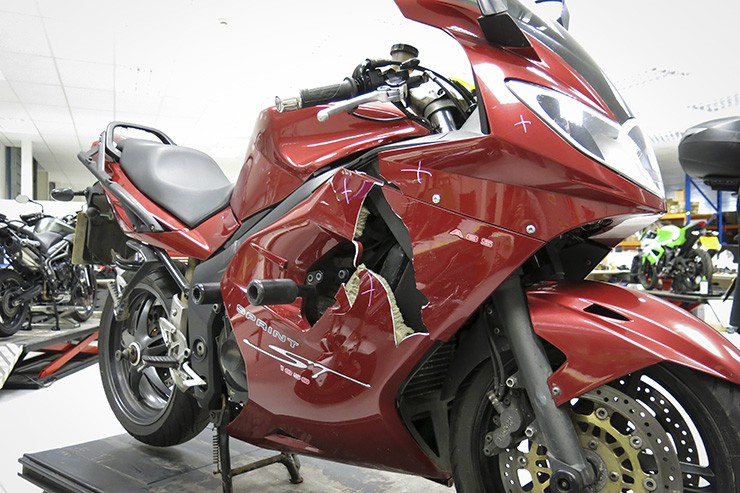
What happens when I call my insurer to make a claim?
All insurers will encourage you to report an incident as promptly as possible, even if you aren’t sure whether you wish to claim. They will make a recommendation of a preferred repairer for you to use, and you can choose to have your bike repaired wherever like, but it’s well worth considering how experienced a repairer is with dealing with insurance companies and potentially complex accident damage – do they have the facility to fully assess all of the potential problems?
Using the insurers’ approved repairer can speed up the claim process and also gives you the comfort of their support and a means of recourse should anything not go according to plan.
What does it mean for a bike to be ‘written off’?
Wherever you decide to have your damage estimate produced, the insurance company will then have an independent engineer look at the damage. It’s important that this person understands motorcycles, as a car requires very different repairs; from paint finishes to structural safety.
Based on the market value of your bike, the underwriter will have set a proportion of the value to determine if a repair is worthwhile, or if the bike should be ‘written off’. In this case, the owner is given money up to the market value, and the machine is sold for salvage.
If any vehicle – motorcycle or car – is written off, it’s given a category. Until October 2017, this was from A down to D…
A. Vehicle must not go back on the road, and all parts must be destroyed.
B. Vehicle must not go back on the road, but serviceable parts can be salvaged.
C. Vehicle deemed a total loss by insurer; it could be repaired, but the costs would exceed the vehicles pre-accident value.
D. Vehicle deemed a total loss by insurer, though it could be repaired, and the costs would NOT exceed the vehicles pre-accident value.
Category C and D motorcycles are often seen for sale – the level of damage they’ve suffered will depend on the market value of the bike when the accident happened. A 15-year-old machine that was written off with category C damage could, for instance, have very minor scrapes compared to a newer bike (of higher value) that might have more serious issues yet only be deemed a category D.
In a bid to make buying salvaged cars more safe, the Association of British Insurers has dropped categories C and D, replacing them with S and N for ‘Structural’ and ‘Non Structural’ damage. A car written off as category S could have a twisted chassis or a collapsed crumple zone, whereas one in category N might have been written off by the insurer for cosmetic damage, or problems with the electrics. However, there could still be issues with the steering or brakes for example, so it should not be considered as safe to drive.
On motorcycles however, there is no category S. If an assessor writes a bike off due to damage to the ‘steering assembly’, the ‘swingarm assembly’, structural damage to the frame, tampering with the VIN/engine number or irreparable engine damage, it will be deemed an A or a B, and will never be seen back on the road.
On the one hand, this means it should restrict the sale of some potentially dangerous salvaged bikes, but on the other, an assessor who doesn’t understand bikes might make a very different call on what they deem to be structural damage, seeing machines taken away from their owners when they could have been repaired.
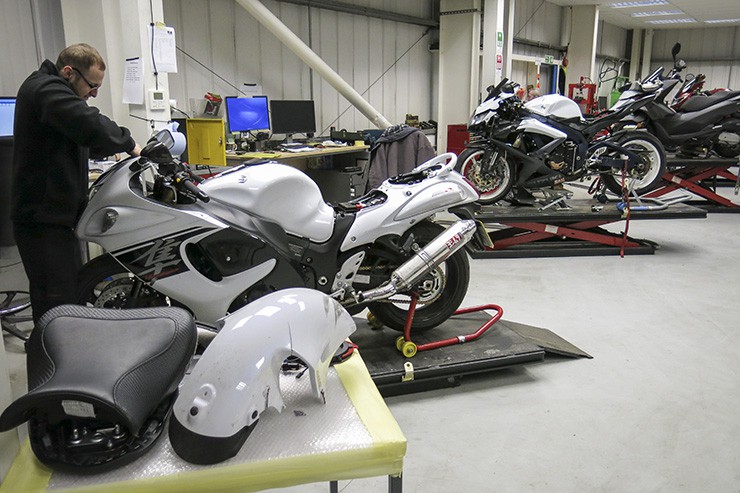
Bikes get written off for things like a scratch on the frame, don’t they?
Yes, but only if the repairer doesn’t, for instance, have the capability to carry out a cosmetic repair, or when the damage is poorly assessed by the inspecting engineer. But it doesn’t have to be like this – underwriters are not pushing to have bikes written off, and this is where an experienced assessor can make the difference between your bike being scrapped, and it being returned to you.
It is the case that some companies looking to repair a motorcycle only consider new replacement parts, whereas – with consultation with the customer – 4th Dimension for example has specialist repair methods that can be used in order to stop a bike being written off, for instance where the customer is very keen to save it.
Can I opt to have my bike written off?
No – if accident damage can be repaired within budget, it will be, but corners will not be cut to make this happen. Where a repair cost is close to the boundary of being written off, 4th Dimension points out that it would consult with the customer, with a view to using its unique and specialist repair methods to save the machine being scrapped.
When are parts on a crashed bike replaced, and when are they repaired?
Any insurance is in place to put you in the position you were in before the vehicle was damaged, be that with the motorcycle in the condition it was, or with you being in the same financial position.
Insurance companies pay out a typical market value, ie the price that bike would be for you to buy (minus your agreed excess of course). While it does take into account the service history, maintenance etc, motorcyclists in particular will too often be frustrated by the fact that it can be extremely hard to find a bike as good as theirs for what its actual market value is.
If a motorcycle is damaged in an accident, an assessor will look at what it would cost to put back to the state it was in before. In 4th Dimension’s case, this is carried out by a team who will take the time to strip the bike, and measure the frame’s geometry if needs be after a heavy accident. A quick tyre-kicking exercise could miss work that needs doing and delay the repair down the line while arguments are had over who pays for potentially missed work, or result in a simple “Nah, it’s had it mate – write it off”.
The cost of any work will need to be within the threshold given by the insurer. For example, a motorcycle might have a market value of £8,000 and a repair threshold of 75% – £6,000. If it can be put back to the same standard as it was before the incident within that cost, it will be. If not, it’ll be written off.
site:bennetts
Весь мото мир в вашем смартфоне, мобильное приложение и социальная сеть для мотоциклистов. Присоединяйся к нам:
Download on theApp StoreDownload on theGoogle Play